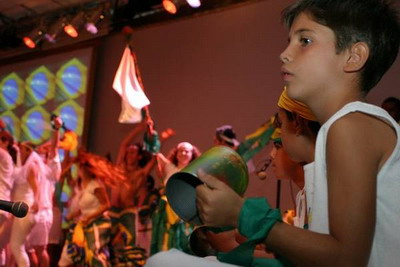
Learning to Live Together, a resource material to nurture ethical values needed to learn to live together in plural societies, is now available for teachers and youth leaders. Read more ...
| We envision a world in which all children are empowered to develop their spirituality — embracing ethical values, learning to live in solidarity with people of different religions and civilizations, and building faith in the Divine Presence. We believe that ethics education will enhance children's innate ability to make positive contributions to the wellbeing of their peers, families, and communities, and that this in turn will help the entire human family to thrive in an environment of greater justice, peace, compassion, hope and dignity. |
Embracing ethical values
Ethics is about life as human beings, about relations and relationships, about living together in a common understanding of what is good and evil.
“ One of the lessons I learned from the story of Adam and Eve in the Garden of Eden is that our first ancestors chose to be human rather than live forever. They chose a sense of morality, a “knowledge of good and evil,” rather than immortality. They spurned the Tree of Life, which would have given them eternal life, in favor of the Tree of Knowledge of Good and Evil, which gave them a conscience. As compensation, God gave humans, who now shared with Him the ability to know good from evil, the gift of His own divine power to create new life. We cheat death, not by living forever, but by bearing, raising, and educating children to keep our souls, our values and even our names alive .”1
Human beings depend on each other for survival. In this interdependence, we “live thanks to others,” and the responsibility of every person is to live “for others” or to live in such a way that brings life to others. Thus, every person is meant to live both “for” and “thanks to” others.
In his book The Ethical Demand , K.E. Loegstrup, the late Danish theologian and Professor in Ethics and Philosophy of Religion, introduced the notion that the ethical demand on humans is refracted like light through a prism, revealing all the different ways in which we find ourselves in relationship with one other.
We hold each other's lives in our hands and we are responsible for each other. And we do not have the consolation of immediate reciprocity. We may lose by carrying the other. It is not a given that we will also be carried. But this is the human condition in which we live or should live, if we are attentive to it.
To live in solidarity with people of different religions and civilizations
Ethics is part of any encounter with people and is intrinsic to life, people of every faith as well as to those who do not identify themselves with a particular faith. It is conveyed through the work and teachings of clergy and laity, men and women, young and old. It is taught by example. It is learned from experience. It is lived by all.2
Life does not discriminate by faith: irrespective of which faith we belong to, we all share certain common experiences — birth, death, joy and pain. We all share in the quest for answers to certain existential questions. In the face of these challenges, religious teachings promote a value-centered code of ethics. Each faith tradition transmits values and ethics through its religious instruction, interpreted in religious life.
There is thus an intrinsic link between ethics education and religious instruction, yet the two are not the same. How is ethics education related to religious education? Can ethics be taught without religious education? How is ethics education different from moral education? All these queries lead to the question of the role of religion in ethics education.
Needless to say, this leaves us with the question of those children and parents who do not identify themselves with any religious tradition. We all know people who do not feel that they can commit themselves to any particular religious tradition and yet they live a life governed by ethical principles that witness to a genuine consideration of the other. Perhaps there is a need to rethink what we mean by belonging to a faith. Is there anything that could be termed communal faith or secular teaching, which is also transmitting values?
Each religious tradition has its own specific self-understanding, which has its own integrity and merits respect in its own right. If we wish to respect all traditions, including secular teachings on ethics, we might want to consider the following: “In my view faith is any appreciation of beauty; any striving for truth; any pursuit of justice; any recognition that some things are good, some are bad. And that it matters ; any feeling or practice of love; any love of what theists call ‘God'; all these and more are examples of personal; and communal, faith” 3 (emphasis added)
In some traditions the distinction between good and bad as absolutes is not a relevant way to look at things. What is particularly important here is the underlined text: that it matters for people, whatever tradition they belong to, that some things are good and some are bad, however we express it.
The kind of ethics that the Interfaith Council wishes to promote has an interfaith context and is about the relationship to the other. It is a matter of attitude rather than a set of dogmas or teachings – it is an approach to life, nature and the other.
Our goal is to facilitate the development of spiritual, moral, cultural and social human beings. How can we improve secular religious education and faith-based religious instruction to enable children and young people to be persons of faith, according to the inclusive definition offered above, and citizens of a culturally religious and plural world?
The kind of ethics that the Interfaith Council wishes to promote implies relationships with others. It is in the practice, not the theory, that we understand each other, other faiths, and thus our own traditions. We can no longer live as if each religion were an island. In today's world, people of religion are bound to live together with people of another religion, and people of no particular religion are bound to intersect with people of religion. We need today to reckon with the other in a different way from what we did 50 years ago. To be a person of faith today is to be inter-religious. Our lives as religious people intersect with the life of other religious people in a way that is today more obvious than ever before.
Empowered to develop one's spirituality
Rev. Takeyasu Miyamoto, who committed the network and endorsed establishing the Interfaith Council on Ethics Education for Children, said, “It is my firm belief that spiritual decline and lack of attention to basic ethics is at the root of the increasing violence and injustice we see all around us today. An essential step on the road to peace is to ensure that every child grows up with full access to her innate capacity for spiritual development, and this is why the implementation of interfaith ethics education — both in schools and in many other “educational” settings — is so vital in accomplishing the goal of building a peaceful world of human dignity, a world fit for children in the truest sense.”
The Interfaith Council will promote an attitude and an approach to the other that is interrelated to the self. The other and self are significant to each other. This is a learning process that evolves like a spiral:
It is through teachings, accompanied by space for free critical thinking, that each child and young person will be able to build and practice a positive relationship with him/herself, the other, the environment and with that which people refer to as God, Ultimate Reality or Divine Presence. This building of positive relationships enriches our innate spirituality, opening up avenues for growth, mutual understanding and respect for people of different religions and civilizations. This will in turn enable children and young people to be partners in building with others a world based on values and practices which contribute to the safeguarding of human dignity and promote solidarity, individual and collective responsibility, reconciliation and faith in that which people refer to as God, Ultimate Reality or Divine Presence. Through this process, children and young people will themselves be teaching and practicing an approach to life based on ethics and values, allowing space for free critical thinking, which will create opportunities to build new positive relationships with oneself, the other, the environment, etc.

The Interfaith Council will not promote a set of global ethics, but new and dynamic thinking on ethics in a global and plural society. This is something all religions can do individually; what is unique about this initiative is that it is done inter-religiously. The Interfaith Council will not create or promote a new religion but will admit and affirm diversity. It is not a new “teaching” but a new way of emphasizing interaction and building positive relationships, a way of promoting ethics and interfaith learning and facilitating new thinking on ethics, which is:
This new and dynamic thinking on ethics in a global and plural world will uphold an approach to the other, signified by the following values:
contributing to universal standards such as:
Throughout this learning process, space will be created for exchange, interaction and understanding, making it possible for children, youth and adults to encounter the other, discovering their own tradition, their own values and the values and tradition of the other in a dynamic process of learning, developed by promoting critical thinking, understanding and an open mind toward the other. The interactions with others create possibilities for mutual enrichment in a continued "receiving and giving" that forms part of our common humanity. We want to give children and young people a chance to grow up with full access to their innate capacity for spiritual development.
Peers, families, communities, and the entire human family
How will this new and dynamic thinking on ethics relate to traditional faith values, and how will ethics education programs interact with the activities of each religious tradition? This is a challenge for each religious tradition and that is why the new and dynamic thinking on ethics will have to be implemented in and engage formal, non-formal and informal educational systems and settings. Formal education is linked with schools and training institutions; non-formal with community groups, religious communities and other organizations; and informal covers what remains, e.g. interactions with friends, family and work colleagues. The distinction is largely administrative but covers all aspects of learning throughout life.
Formal education
Formal education is given within the hierarchically structured, chronologically graded “education system,” running from primary school through university and including, in addition to general academic studies, a variety of specialized programs and institutions for full-time technical and professional training.
Formal learning takes place in school systems, which are established by governments and based on state policies. School systems are political tools of general and ideological state policies, everywhere in the world. Ethics education and interfaith collaboration can best be promoted through advocacy work with government ministries and agencies at various levels, international, regional and local, and by inviting them to work together for this cause. Meanwhile, it will be equally important to assure the identity, objective and focus of the ethics education initiative.
In so far as religious schools are recognized by governments and part of the national school system, they belong to the category of formal learning and need to be solicited and invited to work together with the ethics initiative.
The ethics education initiative can offer:
Non-formal education
Non-formal education can be defined as any organized educational activity outside the established formal system that is intended to serve identifiable learning groupings and learning objectives.
Non-formal learning takes place in school communities, in families, in religious communities, in clubs and networks and in all other formations where people come together around a common interest or because of group affiliation.
The interfaith ethics initiative can best be promoted by approaching neighborhood organizations, other NGOs, faith communities, religious leaders and other local authorities, inviting them to work together to create policies conducive to ethics education. New joint campaigns or activities can be launched and existing ones can be supported.
It will be necessary to assure an interaction between micro and macro levels that is, being conscious about how achievements on the micro level are reflected on the macro level and equally how the macro level contributes to shaping micro level realities. This will assist children and young people in appreciating the interrelationship of the local and the global as well as seeing ethics education as a foundation for a society and world that promotes respect and is sustainable,
Informal education
Informal education is the truly lifelong process whereby every individual acquires attitudes, values, skills and knowledge from daily experience and the educative influences and resources in his or her environment. We see this as taking place in interactions with family and neighbors, in work and play, the marketplace, the library, and the mass media.
An important dimension of informal education reaches us today through the media, such as newspapers, magazines, radio and TV. The media's influence on the transmission of values is not to be ignored, and media experts need to be invited to join the ethics education initiative.
The vital role of children
An intentional pedagogy and methodology will be implemented to assure that children and young people are involved and can play a vital role in ethics education. Children and young people will participate in the selection of the content, disciplines and themes while learning ethics education. Children and young people know about ethical dilemmas from their own experiences, and have a sense of the ethical implications of daily life situations. The learning experience is the process itself, more than the specific choice of situation or content for the learning process.
The form of the process has to be one of participation; a dialogue with consciousness of the way messages are transmitted. The form has to be shaped by:
One must not ignore the potential of power misuse in teaching situations. It is important to foster democratic relationships with as balanced a power dynamic as possible. This is not a case of “adults/teachers” knowing about ethics and values and “children/youth” being ignorant. Rather, all are human beings exchanging ideas, building common understandings and trying to communicate in the best way possible. We all have different ethical codes governing our lives. The critical leap is to be able to imagine and understand the codes of the other; to “jump over” to the other side in order to see and understand his or her code.
The content will be basic documents as well as experiences from working educational situations in the above-mentioned settings. International, national, and regional resources should be made available for the program. One needs to recognize that adults do not need to invent problems or case studies, since children and youth themselves know where the problem lies. Values need to be interpreted and translated to be significant for each group in each region. The content is built by all, and the educational building process is as important as the product or the result.
The institutions to work with include all the educational systems: formal, non-formal and informal education. Ethics education is a life-long learning where all are teachers and pupils in a sharing of values that allow the other to be truly significant.
Methodologies/Tools
The methodology will have dialogue at its center; emphasizing people working with each other. A concern for praxis, that is, action informed and linked to certain values, will guide the methodology. Dialogue deepens understanding, and is part of making a difference in the world. Dialogue in itself is a co-operative activity involving respect. The process is what is important here; enhancing community and building social capital, leading us to act in ways that make a change for justice and human dignity.
The pedagogy → Interactive
Dynamic Critical → Constructive
Free opinions
Free thinking
Reflections for action
Based in daily life
An environment of greater justice, peace, compassion, hope and dignity
The Mission of the Interfaith Council on Ethics Education for Children is to promote ethics education in co-operation with all sharing this vision, seeking partnerships and developing alliances with religious communities,United Nations agencies, NGOs, and a broad range of others in the effort to realize the right of the child to full and healthy physical, mental, spiritual, moral and social development and the right of the child to education set out in the Convention on the Rights of the Child.
The Convention on the Rights of the Child (CRC) is the framework in which the interfaith initiative positions its work. The Interfaith Council promotes ethics education as an attitude and an approach to the other which is learned through free critical thinking. There is in this objective a clear reference to articles 12, 13 and 14 of the CRC. In addition, the right to education is expressed in articles 28 and 29, and in article 30 we find that respect for religious or indigenous minorities is highlighted.4
The right to education is stated in many international legal instruments: the Universal Declaration of Human Rights (1948), the International Covenant on Economic, Social and Cultural Rights and on Civil and Political Rights (1966), the Convention on the Elimination of All Forms of Discrimination Against Women (1979), the UNESCO Convention against Discrimination in Education (1960), the European Convention on Human Rights and Fundamental Freedoms (1950) and comments 11 and 13 of the Committee on Economic, Social and Cultural Rights.5
Reading the UN international legal documents, it is clear that the UN discourse does not use the term “ethics education.” We can, however, find the concept of values-based education in expressions such as “quality education” and “moral education.” There are examples in article 13 of the International Covenant on Economic, Social and Cultural Rights and in article 18 of the International Covenant on Civil and Political Rights. These articles state that the State must ensure the religious and moral education of its children in conformity with their own convictions. In article 5 of the UNESCO Convention against Discrimination in Education, we can again see the importance of ensuring “the religious and moral education of children” according to their own convictions.
What has UNESCO said that might enhance the initiative of ethics education and the work of the Interfaith Council?
In April 2000 in Dakar , Senegal , the World Education Forum adopted the Dakar Framework of Action. 1100 participants reaffirmed their commitment to achieve “Education for All” by 2015. UNESCO was designated as the body responsible to co-ordinate all the regional and international agencies and institutions involved in partnership with governments.
Re-affirming the World Declaration of Education for All (Jomtien 1990), the Dakar Conference on Education set goals and strategies of action to ensure education for all. The Dakar Framework of Education promotes free and compulsory primary education, especially for vulnerable and disadvantaged children, and ethnic minorities. Like Interfaith Council, the Dakar framework gives special emphasis to quality education (goals 2, 5, 6) and affirms that successful education programs require among other things “a clear definition and accurate assessment of learning outcomes, including knowledge, skills, attitudes and values” (goal 6).
The Interfaith Council aims to promote ethics education in a global and pluralist society. The Council promotes an inter-religious approach in response to this diversity, teaching values that promote mutual understanding, respect for human dignity and people of different backgrounds; promote reconciliation and the individual and collective responsibility to contribute to universal standards such as peace, justice and equality. This approach is in harmony with article 4 of UNESCO's 1995 Declaration of Principles of Tolerance. According to UNESCO, education for tolerance means building the capacity to develop independent judgment as well as free and ethical thinking, and gives support to the implementation of programs to develop human rights education and a culture of non-violence.
The intention of the Interfaith Council in developing a methodology and pedagogy of ethics education is a contribution to the pledge of UNESCO member States in the Declaration of Principles of Tolerance, supporting and implementing programs to make citizens open to other cultures, respectful toward the other, and capable of resolving differences in a peaceful way.
UNICEF has been instrumental together with others in developing “A World Fit for Children.” Where are the links to ethics, values and ethics education?
UNICEF has promoted, among other UN bodies and partners, the holding of two Special Sessions on Children of the General Assembly. The first one in 1990 produced a Plan of Action for implementing the World Declaration on the Survival, Protection and Development of Children. The second one, in 2002, produced the document “A World Fit for Children,” that, following up on the commitments issued in 1990, makes an appeal to build a better world for children, underlining the goals and targets to be reached according to major UN summits and conferences, in particular, the Millennium Development Goals.
One of the specific actions of the Plan for Implementing the World Declaration on the Survival, Protection and Development of Children is to increase access to education and literacy. In the Plan of Action of the 2002 document “A World Fit for Children,” one main goal, strategy and action agreed on is to provide not only access to education, but also quality education. Quality education is a human right, and is an important tool for reducing poverty and promoting democracy, peace, tolerance and development.
The Interfaith Council promotes quality education as described in the second goal of the declaration “A World Fit for Children” adopted at the Special Session on Children in 2002. Quality education should be accessible to all children, and is respectful of indigenous and other minorities. The ethics education promoted by the Interfaith Council fully reflects the promotion and protection of human rights and the values of peace, tolerance and equality as defined in the 2002 Plan of Action of the Special Session on Children. The ethics education of the Interfaith Council avoids discriminatory practices and other negative social or cultural attitudes as described in the declaration and promotes a culture of peace.
Links to peace education and to human rights education
Every year, the Commission on Human Rights adopts resolutions concerning the rights of the child and the right to education. The Commission recalls the main international standards related to the right to education and urges all States to improve the quality of education for children, respecting children belonging to minorities. The objective of the Interfaith Council can be seen as a direct response to the Commission's annual resolutions. Special attention should be given to the 2004 Commission of Human Rights, where the Commission decided to develop a World Program for Human Rights Education 6. Representatives from ministries of education, teacher organizations, research institutions, NGOs, UN agencies and other partners from around the world have given their input into the draft plan of action for the first phase, scheduled to take place in 2005-2007.
The UN Special Rapporteur on the Right to Education has stated that this plan “will contribute to the achievement of the Second Millennium Development Goal on universal primary education by promoting rights-based quality education” 7. The Interfaith Council initiative shares the vision of the Special Rapporteur, in which human rights education is an integral part of the right to education and as a strong component of quality education.
ANNEX
Didactics
Promoting praxis development through a process of
THEORY + PRACTICE IN LIFE → PRAXIS

The methodology and didactics imply a need for:
The material for ethics education will be tested in several workshops with different participation and settings before it is published and ready for use. An evaluation plan will be developed to assure quantitative as well as qualitative evaluation of projects and initiatives promoting ethics education. External evaluators will be engaged to work with trainers and beneficiaries to allow for a participatory approach to the evaluation process.
The long-term process of the Interfaith Council on Ethics Education for Children foresees a period of 10 years up to 2015, by which time several ethics education programs will have been implemented within the three types of educational settings. The external evaluation will be conducted at this time with suggestions for direction and focus for a new phase of the ethics education initiative.
The medium-term goal (by 2010) is that at least one ethics education program will be in operation in each of the GNRC regions. An internal interim assessment of the ethics education initiative and its material will be conducted around this time.
The short-term goal (by 2007) is that a manual for ethics education will have been tested, published and put into practice by selected GNRC regions and other interested partners.
Send to a friend
more...